PlasmidLab / Guides / Gateway® cloning
Gateway® cloning: what BP and LR do
Gateway® moves a segment between plasmids by recombination, with nothing cut and nothing ligated. Two reaction names cover the whole system.
PlasmidLab is not affiliated with or endorsed by Thermo Fisher Scientific.
Ask the agent
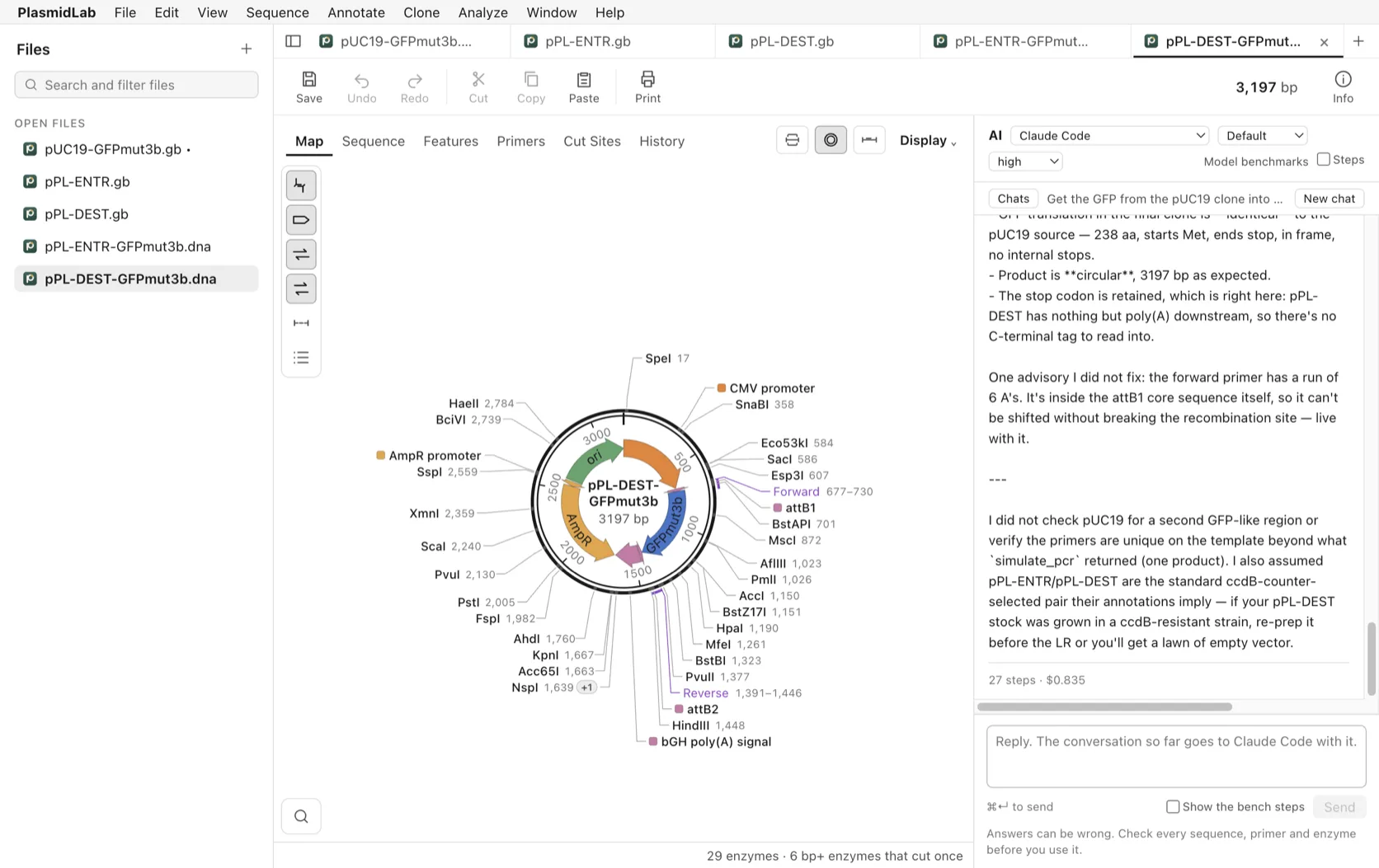
Open the source, the donor and the destination vector, and ask for the route through both reactions.
Get the GFP from the pUC19 clone into pPL-DEST, by way of an entry clone in pPL-ENTR. Tell me what to plate on at each step.

The agent designed the attB-tailed primers, ran the BP reaction into the donor to make the entry clone, then the LR into the destination, and wrote both plasmids out as tabs. It also answered the part of the question the menus cannot: what to plate on after each step, and the warning that a destination vector grown in a ccdB-resistant strain gives a lawn of empty vector.
Or do it yourself
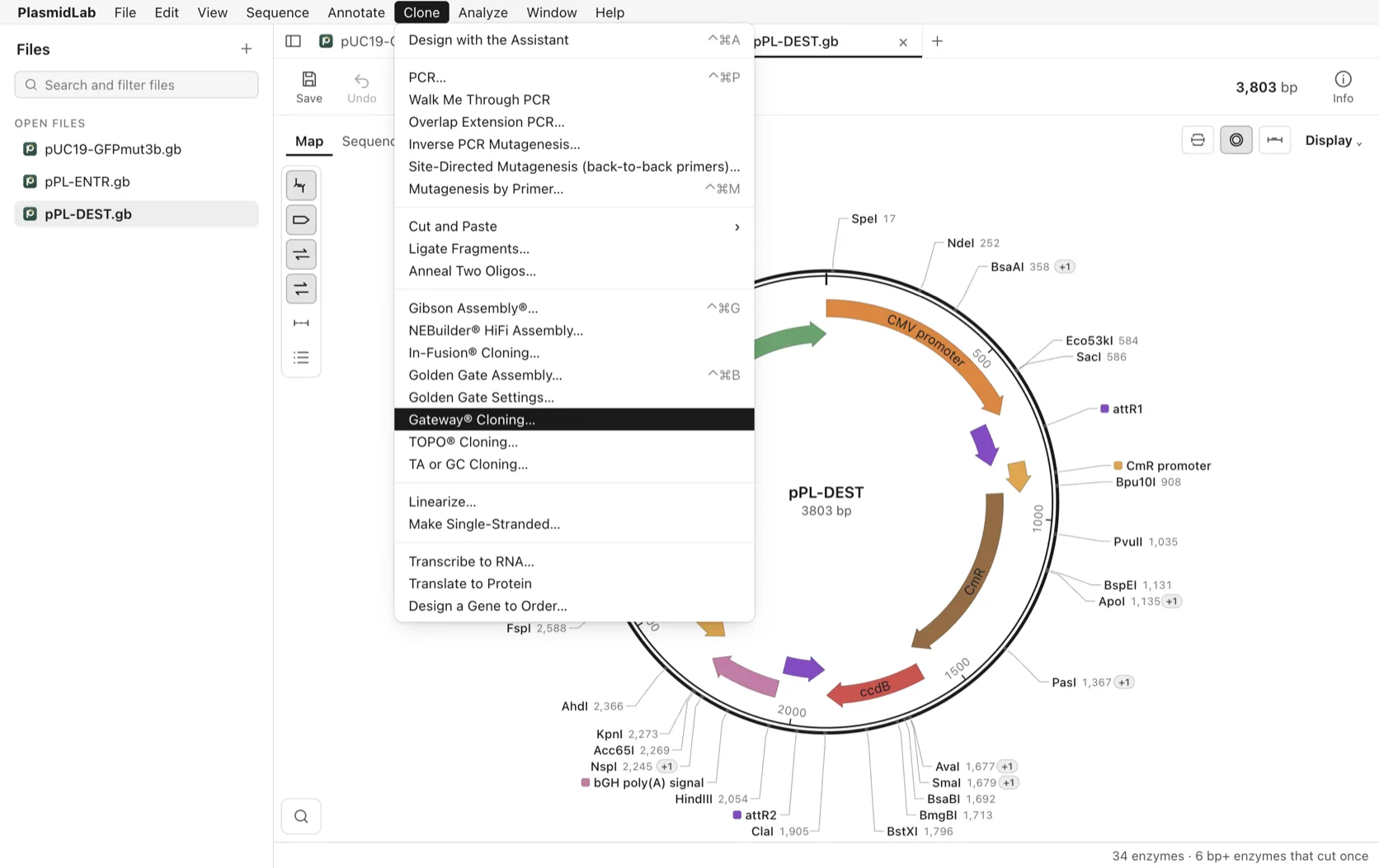
Clone > Gateway® Cloning… runs BP, LR, or both in one pass, and writes out the entry clone it made on the way as well as the expression clone.
What the two reactions are
BP joins attB and attP and leaves attL and attR: an insert with attB ends plus a donor vector gives an entry clone. LR joins attL and attR and leaves attB and attP: the entry clone plus a destination vector gives the expression clone. One entry clone can go into as many destination vectors as you like, which is the point of the system.
Sites come in numbered pairs, 1 with 1 and 2 with 2, so the insert can only land one way round. Donor and destination vectors carry ccdB between their sites; its product poisons DNA gyrase, so only the recombined plasmid forms colonies, and the vectors themselves have to be kept in a ccdB-resistant strain. An att site ends up between a vector tag and your insert and is translated, so for an N-terminal tag the frame has to run through attB1 into your coding sequence.
Before you order
Read the product before you spend money on oligos: the sequence at each junction, the reading frame through a coding fusion, and the feature orientation. A design is not experimental validation, and the agent can be wrong.