PlasmidLab / Guides / Golden Gate assembly
Golden Gate assembly: choosing the overhangs
A Type IIS enzyme cuts outside its own recognition sequence, so the four bases that join two pieces are yours to choose and the enzyme site leaves the product.
Ask the agent
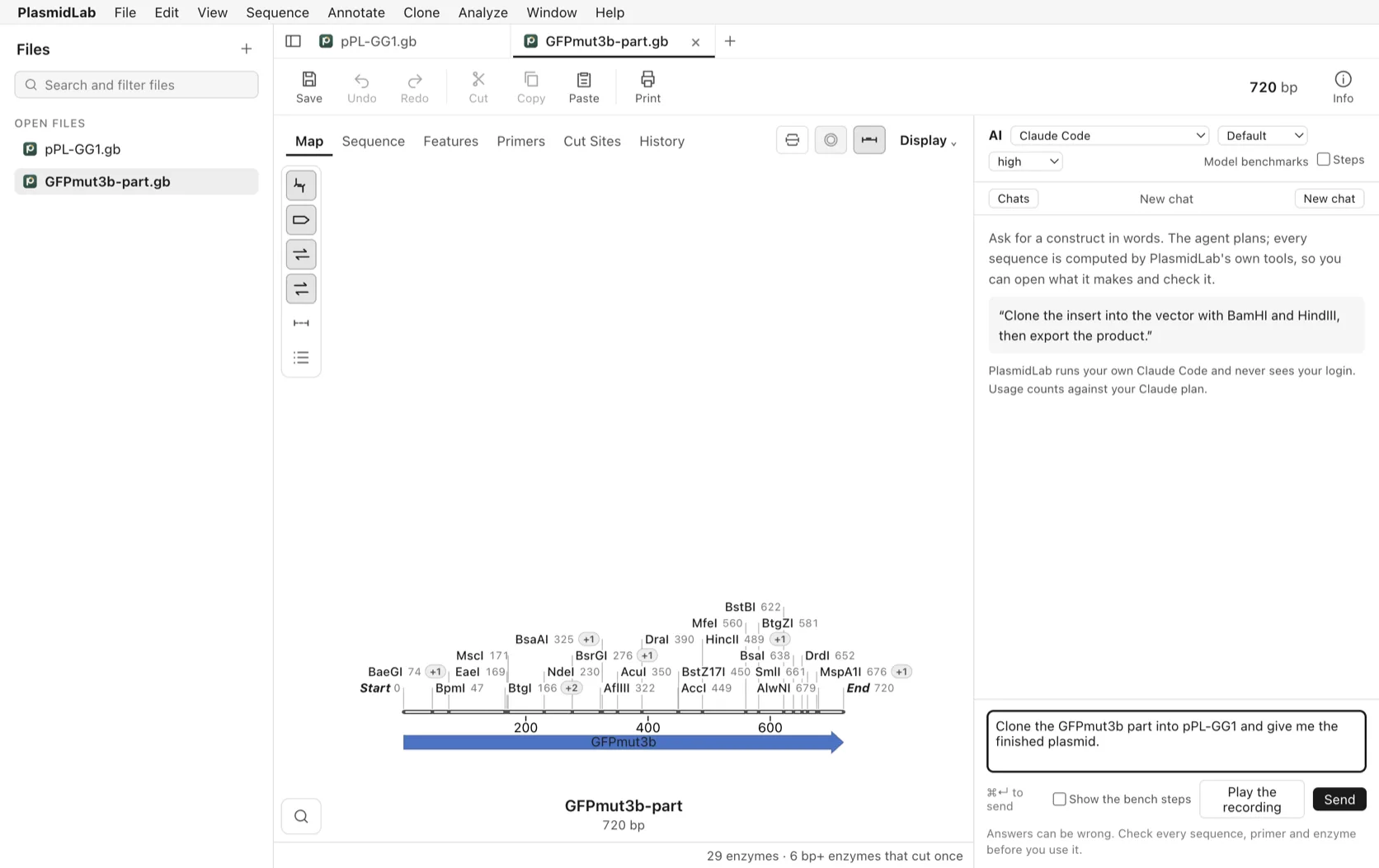
Open the acceptor and the part, then ask for the finished plasmid.
Clone the GFPmut3b part into pPL-GG1 and give me the finished plasmid.
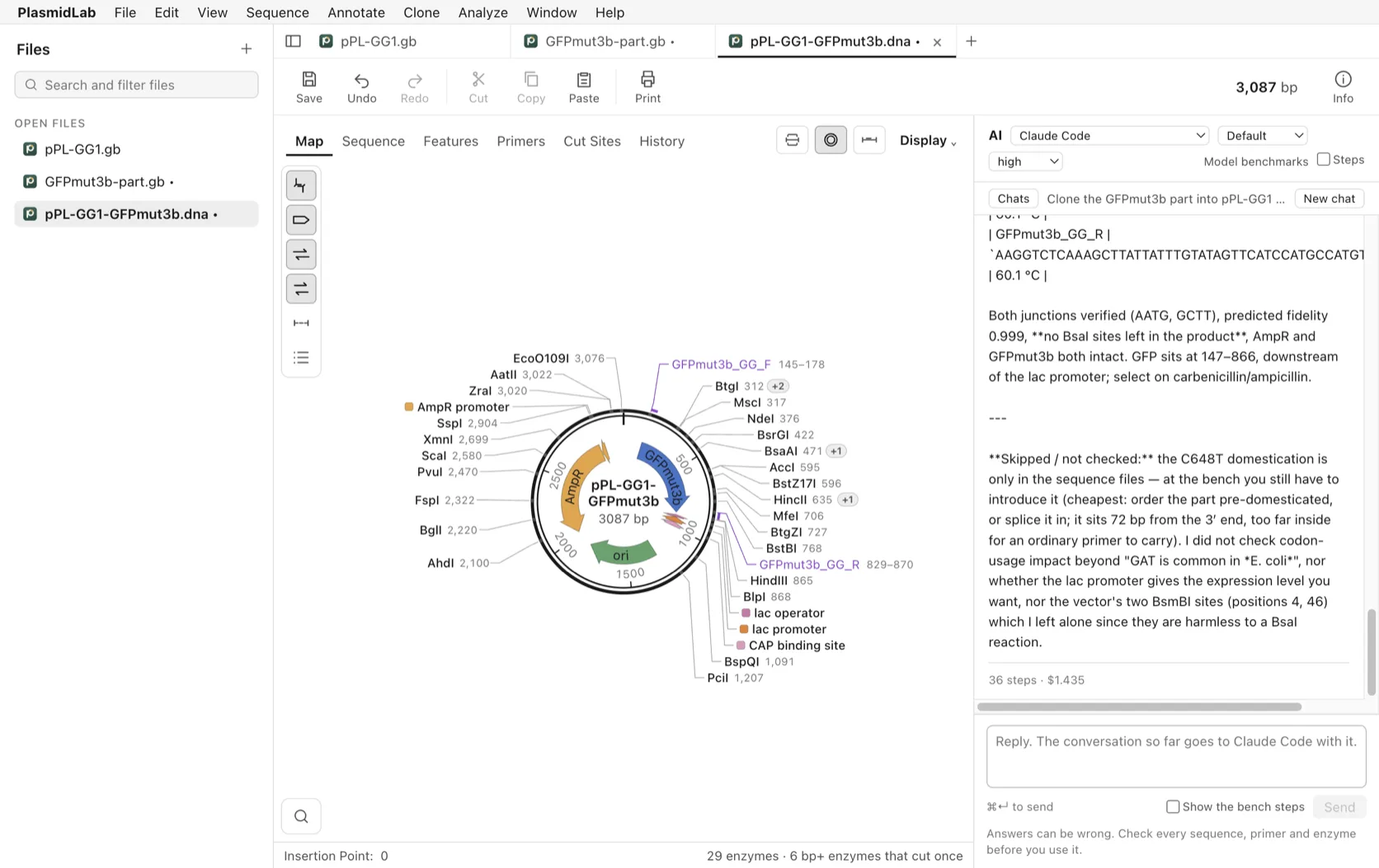
In this run the agent found a BsaI site inside the part, removed it with a silent change, picked the AATG and GCTT overhangs, and built the 3,087 bp plasmid. It also said plainly that the silent change exists only in the file so far, and that the part has to be ordered or repaired at the bench.
Or do it yourself
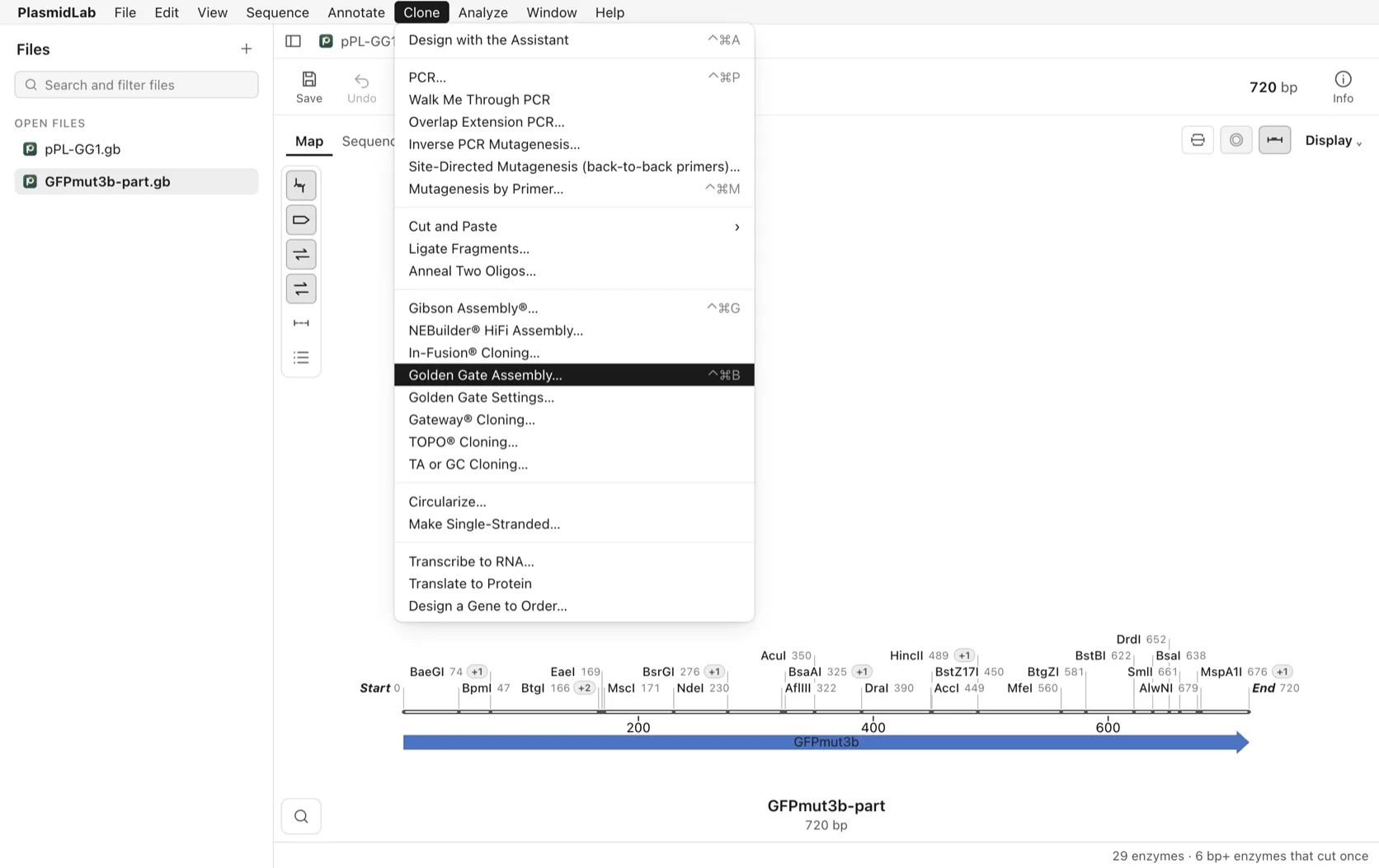
Choose Clone > Golden Gate Assembly…, add one slot per insert and set each piece's orientation. The enzyme and the rest of the options live in Clone > Golden Gate Settings….
Choosing the overhangs
BsaI is written GGTCTC(1/5): it cuts the top strand one base past the site and the bottom strand five past it, leaving a four-base 5′ overhang. BsmBI (Esp3I) is CGTCTC(1/5) and BbsI is GAAGAC(2/6). Every junction needs its own overhang, and the set has to be unambiguous: no overhang matching another or another's reverse complement, no palindromes such as AATT, no pair differing at a single base, and nothing at 0% or 100% GC, for example AAAA or GGGG. NEB publishes measured fidelity for whole sets, which is worth checking past four or five junctions.
A part that contains the recognition sequence gets cut during the reaction, so those sites have to go first. To see them, use Analyze > Use Enzyme Set > Type IIS enzymes, or paste the sequence into the restriction site finder. For a check you can repeat: pUC19 (NCBI L09137, 2,686 bp, circular) has one BsaI site, cutting the top strand after base 1,760, and two BsmBI sites, after bases 3 and 45. BbsI does not cut it.
Before you order
Read the product before you spend money on oligos: the sequence at each junction, the reading frame through a coding fusion, and the feature orientation. A design is not experimental validation, and the agent can be wrong.